
Skip to content

Guide

Free printable food safety logs

A food safety log is a dated record of each check: what was checked, the reading, the limit, who took it, and what was done when it was out of range. Here are six blank sheets to print — one page each, with the limits on them.

Kitchen on Hand · Updated

What a food safety log is for

A log is the kitchen’s written record that a check was done. Each line says what was checked and when, the reading, the limit it was held to and who took it — and, when the reading was out of range, what was done about it.

A reading out of range with the fix written beside it is the log doing its job. Write the real number every time, not a check mark: a column of check marks can’t show whether anything was ever wrong.

How to use these sheets

Print a few of each and keep them on a clipboard where the check happens: on the walk-in door, by the steam table, at the dish sink, by the back door for deliveries. Fill them in by hand, in pen, as you take each reading, and put your initials on every line.

Made a mistake? Cross it out with one line so it can still be read, and write the right entry beside it — don’t erase it or paint over it. When a sheet is full, start a new one and keep the full one with the others, in order.

How often to check, and how long to keep them

The sheets are laid out for a common routine — walk-ins in the morning and the evening, hot food at least every 2 hours, cooling at the 2- and 6-hour marks. But how often to take each reading, which logs you need and how long to keep the sheets all vary from place to place.

What your health department requires is theirs to say: ask them, and keep their answer with the sheets. The limits printed on each sheet start from the FDA Food Code, and your health department may set its own. Where it does, write theirs on the sheet.
Sheet 1 of 6

Walk-in, fridge & freezer temperature log

What it’s for
The air temperature in each walk-in, fridge and freezer, read in the morning and again in the evening. Keep a sheet on each unit, and write which unit it is at the top.
The limit
  • Walk-in or fridge: 41°F or below
  • Freezer: 0°F or below

41°F or below keeps cold food out of the danger zone. A freezer should hold 0°F or below, so food stays frozen solid.

Taking the reading
Read the unit thermometer. Write the time beside each reading.
When it’s out of range
Write the reading as it is, write what you did under Action taken, and tell a manager. What to do with food that was held too warm is for your health department to say — ask them.
Download the PDF of the walk-in, fridge & freezer temperature log (Letter, 1 page)

Walk-in, fridge & freezer temperature log

kitchenonhand.com

Restaurant:

Unit / location:

Month:

Limit
Walk-in or fridge: 41°F or belowFreezer: 0°F or below
How to check
Read the unit thermometer. Write the time beside each reading.
Out of range
Write the reading as it is, write what you did under Action taken, and tell a manager. What to do with food that was held too warm is for your health department to say — ask them.
DateAM timeAM temp °FPM timePM temp °FOK?Action takenInitials

Preview — the printed sheet has 20 lines. Swipe the table sideways to see every column.

Limits start from the FDA Food Code; your health department may set its own.

Sheet 2 of 6

Hot holding log

What it’s for
The temperature of each food you hold hot — on the steam table, in the rice warmer, in a soup well — taken through service. One line per food, each time you check it.
The limit
  • Hot-held food: 135°F or above
Taking the reading
Check each hot-held food at least every 2 hours, at its coldest spot (pan edges).
When it’s out of range
Below 135°F: reheat to 165°F if it was 135°F or above in the last 2 hours, otherwise throw it out — and write down what you did.

Hot holding log

kitchenonhand.com

Restaurant:

Station:

Month:

Limit
Hot-held food: 135°F or above
How to check
Check each hot-held food at least every 2 hours, at its coldest spot (pan edges).
Out of range
Below 135°F: reheat to 165°F if it was 135°F or above in the last 2 hours, otherwise throw it out — and write down what you did.
DateTimeFood itemTemp °F135°F or above?Action takenInitials

Preview — the printed sheet has 20 lines. Swipe the table sideways to see every column.

Limits start from the FDA Food Code; your health department may set its own.

Sheet 3 of 6

Cooling log

What it’s for
Cooked food you’re cooling to keep — stock, rice, beans, a braise — on its way from hot to cold. One line per batch, from the moment it leaves the heat.
The limit
  • At 2 hours: 70°F or below
  • At 6 hours: 41°F or below

Cooked food must cool from 135°F to 70°F or below within 2 hours. Cooked food must be at 41°F or below within 6 hours of leaving 135°F — 4 hours after the 2-hour check.

Taking the reading
Write down the time the food leaves 135°F. Take its temperature with a probe thermometer at the 2-hour mark and again at the 6-hour mark, and write the time and the reading each time.
When it’s out of range
If it misses either limit, write what you did under Action taken and tell a manager. What to do with food that cooled too slowly is for your health department to say — ask them.

Cooling log

kitchenonhand.com

Restaurant:

Month:

Limit
At 2 hours: 70°F or belowAt 6 hours: 41°F or below
How to check
Write down the time the food leaves 135°F. Take its temperature with a probe thermometer at the 2-hour mark and again at the 6-hour mark, and write the time and the reading each time.
Out of range
If it misses either limit, write what you did under Action taken and tell a manager. What to do with food that cooled too slowly is for your health department to say — ask them.
Food itemDateTime off heat (135°F)2-hour time2-hour temp (70°F or below)6-hour time6-hour temp (41°F or below)Action takenInitials

Preview — the printed sheet has 20 lines. Swipe the table sideways to see every column.

Limits start from the FDA Food Code; your health department may set its own.

Sheet 4 of 6

Sanitizer log

What it’s for
The strength of the sanitizer in your 3-compartment sink and your sanitizer buckets. One line per test, with which sink or bucket it was.
The limit
  • Chlorine (bleach): 50–100 PPM
  • Quat: the range on your product’s label (most are 200–400 PPM)
  • Iodine: 12.5–25 PPM
Taking the reading
Dip a test strip in the sanitizer compartment or the bucket, and match its color to the chart on the container. Use strips made for the sanitizer you use.
When it’s out of range
Remake it and test it again before it’s used, and write what you did under Action taken.

Sanitizer log

kitchenonhand.com

Restaurant:

Month:

Limit
Chlorine (bleach): 50–100 PPMQuat: the range on your product’s label (most are 200–400 PPM)Iodine: 12.5–25 PPM
How to check
Dip a test strip in the sanitizer compartment or the bucket, and match its color to the chart on the container. Use strips made for the sanitizer you use.
Out of range
Remake it and test it again before it’s used, and write what you did under Action taken.
DateTimeSink or bucketSanitizer typeReading (PPM)In range?Action takenInitials

Preview — the printed sheet has 20 lines. Swipe the table sideways to see every column.

Limits start from the FDA Food Code; your health department may set its own.

Sheet 5 of 6

Receiving log

What it’s for
The temperature of refrigerated and frozen food as it arrives, checked at the door before it goes on the shelf. One line per item you check.
The limit
  • Refrigerated: 41°F or below
  • Frozen: 0°F or below, frozen solid

Cold food must arrive at 41°F or below. Frozen food must arrive frozen solid, at 0°F or below.

Taking the reading
Refrigerated: put the probe in the middle of the package or the thickest part. Frozen: check the middle of a box.
When it’s out of range
Write whether you accepted it, and what you did under Action taken — sent it back with the driver, for example.

Receiving log

kitchenonhand.com

Restaurant:

Month:

Limit
Refrigerated: 41°F or belowFrozen: 0°F or below, frozen solid
How to check
Refrigerated: put the probe in the middle of the package or the thickest part. Frozen: check the middle of a box.
Out of range
Write whether you accepted it, and what you did under Action taken — sent it back with the driver, for example.
DateVendorItemTemp on arrival °FAccepted?Action takenInitials

Preview — the printed sheet has 20 lines. Swipe the table sideways to see every column.

Limits start from the FDA Food Code; your health department may set its own.

Sheet 6 of 6

Thermometer calibration log

What it’s for
A check that each probe thermometer still reads true, in ice water. Every other reading on these sheets is only as good as the thermometer that took it.
The limit
  • In ice water: 30–34°F

It should read 32°F (±2°).

Taking the reading
Fill a cup with ice and a little water, wait 1 minute, insert the probe without touching the sides.
When it’s out of range
Outside that: recalibrate or replace, then re-test. Write what you did under Action taken.

Thermometer calibration log

kitchenonhand.com

Restaurant:

Year:

Limit
In ice water: 30–34°F
How to check
Fill a cup with ice and a little water, wait 1 minute, insert the probe without touching the sides.
Out of range
Outside that: recalibrate or replace, then re-test. Write what you did under Action taken.
DateThermometerIce-water reading °FOK? (30–34°F)Action takenInitials

Preview — the printed sheet has 20 lines. Swipe the table sideways to see every column.

Limits start from the FDA Food Code; your health department may set its own.

In Kitchen on Hand

Or record them on the phone

In Kitchen on Hand, the cook records each reading on the phone and the app judges it against the log’s limit. A failing reading asks what was done about it, and a manager signs off. The logs start from the same library as these sheets.

For each log you pick who is notified when a reading fails or a scheduled check is 30 minutes late. Readings save on the phone with no signal in the walk-in, and the record prints or exports as a spreadsheet.

Try it free for 30 days, no card
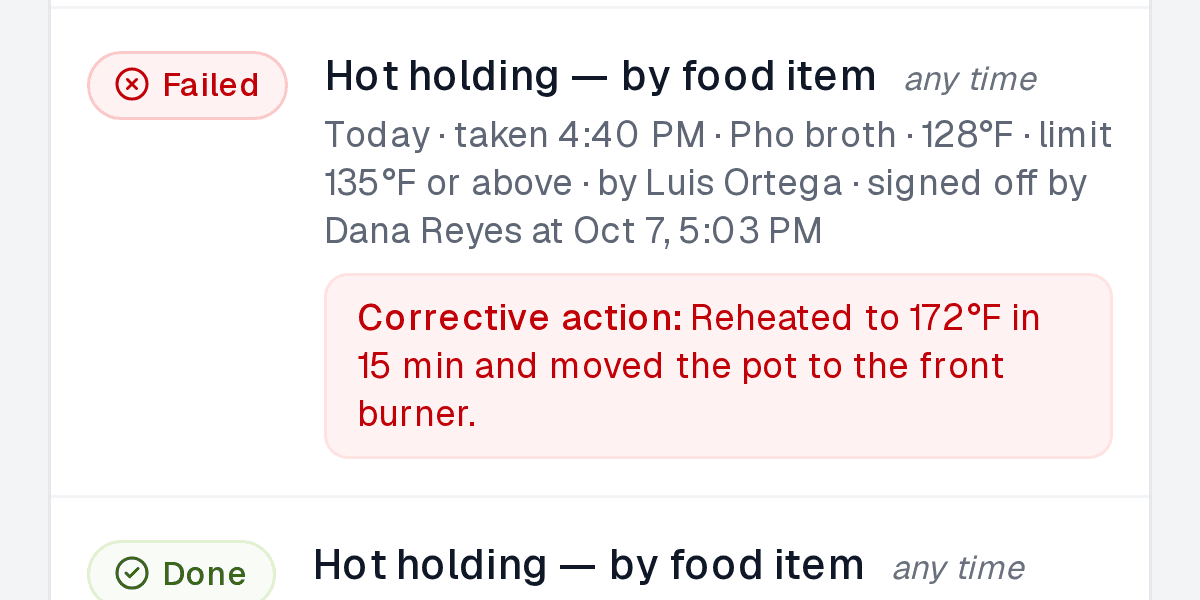
A failed hot-holding reading in Kitchen on Hand: Pho broth at 128°F against a limit of 135°F or above, taken by Luis Ortega and signed off by Dana Reyes, with the corrective action — reheated to 172°F and moved to the front burner.

Real screens from the app, using an example kitchen.

Questions

Food safety log questions

Are these food safety logs really free?

Yes. Print them from this page or download the PDFs, and make as many copies as you like. There’s nothing to sign up for.

Are these the logs my health department requires?

They’re blank sheets for keeping the record; what your health department requires is theirs to say. Ask them which logs they expect, how often to take each reading and how long to keep the sheets. The limits on the sheets start from the FDA Food Code, and your health department may set its own.

What do I write when a reading is out of range?

The reading as it is — never a better number — and what was done about it under Action taken, with your initials. Where there’s a set rule, the sheet says what to do, such as reheating or throwing out hot-held food that dropped below its limit. If you check again afterwards, write the new reading on a line of its own.

Why does the cooling log have two checks?

Because the limit drops halfway. Cooked food must cool from 135°F to 70°F or below within 2 hours. Cooked food must be at 41°F or below within 6 hours of leaving 135°F — 4 hours after the 2-hour check. One line on the sheet covers both checks for one batch.

How long should I keep food safety logs?

That’s up to your health department, and it varies — ask yours. Keep full sheets in order by month, so a past week is easy to find when someone asks for it.

Can we keep these logs on a phone instead of paper?

Yes. In Kitchen on Hand the cook records the reading on the phone, the app judges it against the log’s limit, a failing reading asks what was done about it, and a manager signs off. The record prints or exports as a spreadsheet. Whether a record kept on a phone works for your health department is theirs to say.

Free tools

More for your kitchen, free

  • Calculator

    Food cost calculator

    Food cost % for a week or month, what one plate costs to make, and the menu price that hits your target.

  • Calculator

    Par level calculator

    How much of an item to keep on the shelf between deliveries, and how much to order today.

  • Guide

    How to take restaurant inventory

    When to count, how to count and value it, and how to turn the count into food cost — with a free printable count sheet.

Walk your kitchen with it tomorrow morning.

Sign up, photograph an invoice, check the items it read, and walk the line with it. Free for 30 days, no card to start.

You’ll need your last invoice or order guide, and about 10 minutes.