
Free calculator
Food cost calculator
Work out food cost % for a week or a month, what one plate costs to make, and the menu price that hits your target.
Works right here in your browser. Nothing you type is saved or sent anywhere.
Food cost % for a week or a month
Use the same dates for all four numbers — from one inventory count to the next.
What your last count was worth.
Food delivered since that count, from your invoices, minus any credits. Leave out paper goods and cleaning supplies.
What today’s count is worth.
Food sales for the same dates, after discounts and comps, before tax.
- Beginning inventory
- —
- + Purchases
- —
- − Ending inventory
- —
- = Food used
- —
- Food sales
- —
Plate cost and menu price
List what goes on one plate and what that amount of each ingredient costs. Add a menu price to see the plate’s food cost % and profit, or a target % to see what to charge.
- Menu price
- —
- − Plate cost
- $0.00
- = Profit per plate
- —
Many full-service restaurants aim for roughly 28–35%. Yours depends on your menu and prices.
How it works
The formulas, in plain English
Both calculators do the arithmetic below and nothing else, so you can check any result by hand.
Food cost % for a period
Food cost percentage is how much of every dollar of food sales went on the food itself. For a week or a month it comes from two inventory counts and the invoices between them.
Food used = beginning inventory + purchases − ending inventory
Food cost % = food used ÷ food sales × 100
Beginning inventory is what your last count was worth. Purchases are the food delivered since then, from your invoices, minus any credits for returns; leave out paper goods and cleaning supplies that come on the same invoices. Ending inventory is what today’s count is worth. What’s left over is the food that was used — sold, wasted, spoiled or given away.
Divide that by food sales for the same dates, after discounts and comps, before tax. Keep drinks out of both sides if you buy and sell them separately, and value both counts the same way — the inventory guide walks through a count step by step.
Example — made-up round numbers
- Beginning inventory
- $10,000.00
- + Purchases
- $25,000.00
- − Ending inventory
- $11,000.00
- = Food used
- $24,000.00
- Food sales
- $80,000.00
- Food cost: $24,000 ÷ $80,000 × 100
- 30.0%
“Try the example” in the first calculator fills in these numbers.
Plate cost, food cost % and menu price
Plate cost is what one serving costs to make: the cost of the amount of each ingredient that goes on the plate, added up. An ingredient’s cost per plate is what you pay for it divided by the portions it makes — for example, a $20.00 bag of rice that makes 50 portions is $0.40 a portion.
Cost meat and produce at the weight as bought, not the weight on the plate. If trimming or cooking loses a quarter of it, a 6 oz portion takes 8 oz: at $4.00 a pound, that’s $2.00, not $1.50.
Plate cost = every ingredient’s cost for its portion, added up
Food cost % = plate cost ÷ menu price × 100
Profit per plate = menu price − plate cost
Menu price for a target = plate cost ÷ (target % ÷ 100)
Profit per plate here is before labor, rent and everything else: it’s what the plate leaves you to pay those with. The last line runs the food cost % line backwards: pick the food cost you want and it tells you what to charge. The calculator rounds that price up to the cent, so the plate lands at or just under your target.
Example — made-up round numbers
- Chicken
- $2.25
- Rice
- $0.40
- Vegetables
- $1.10
- Sauce and garnish
- $0.75
- = Plate cost
- $4.50
- Menu price
- $15.00
- Food cost: $4.50 ÷ $15.00 × 100
- 30.0%
- Profit per plate: $15.00 − $4.50
- $10.50
- Price for a 28% target: $4.50 ÷ 0.28, rounded up
- $16.08
“Try the example” in the second calculator fills in these numbers.
In Kitchen on Hand
Food cost from every count, without the spreadsheet
Count the shelves on your phone, storage area by storage area. When you finish, the count is valued at the prices you paid. From your last count and the deliveries you received in the app, it works out the food that left the shelves — the food used above, with the waste you’ve logged included and shown on its own line, so waste counts toward food cost. Enter food sales for the same stretch and it shows food cost %, and what waste alone cost as a share of sales.
Recipes cost out from the items you actually buy — by the case, pound, ounce or bottle — with cost per serving, profit and margin for each dish.
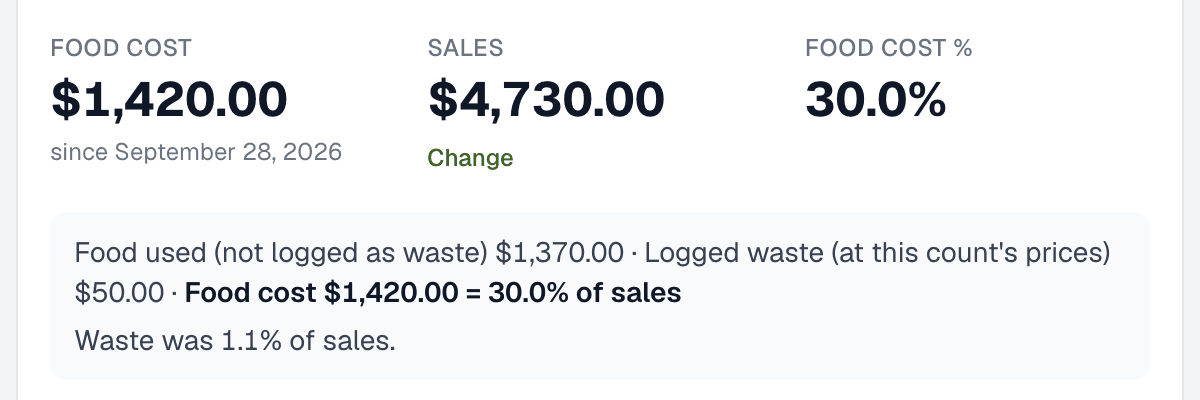
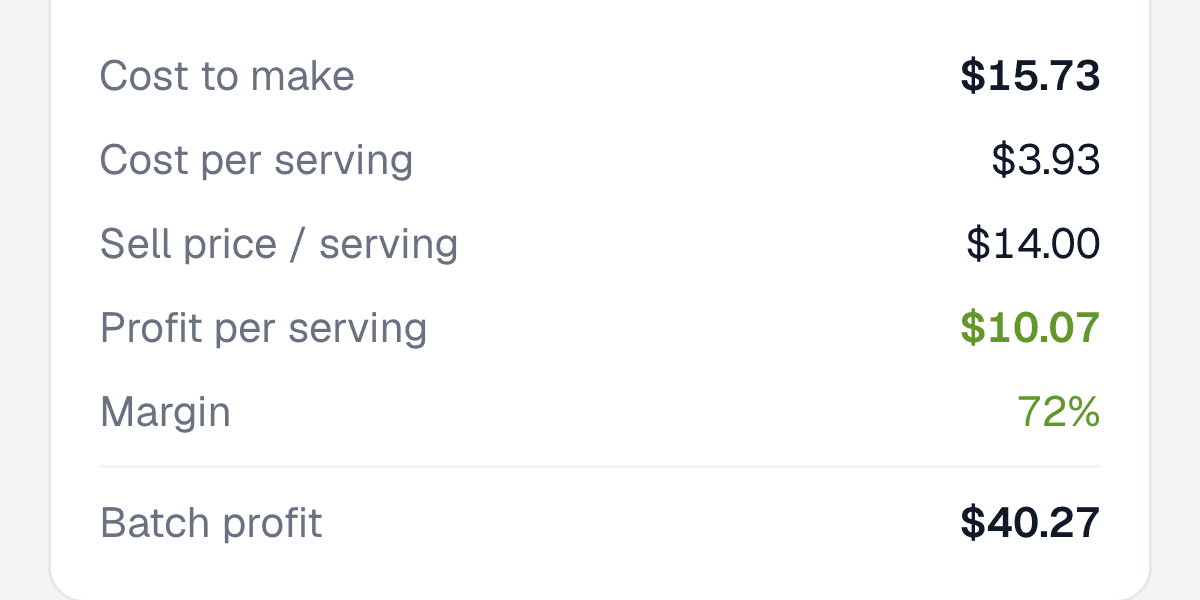
Real screens from the app, using an example kitchen.
Questions
Food cost questions
What is a good food cost percentage?
There isn’t one right number. As a rough rule of thumb, many full-service restaurants aim for somewhere around 28–35%, but the right figure depends on your menu, your prices and how you serve. The most useful comparison is your own number from one period to the next, worked out the same way each time.
What’s the difference between food cost % for a period and plate cost?
Plate cost is what a dish should cost when it’s made exactly to recipe. Food cost % for a period is what the kitchen actually used — including waste, spoilage, over-portioning and staff meals. When the period’s number runs above what your plate costs suggest, much of the difference is usually food that left without being sold. Plate costs built on old prices, comps and discounts, or a counting mistake can also open the gap.
Should drinks be included?
Keep them separate if you can: food purchases against food sales, and beverage purchases against beverage sales. Mixed together, a problem in one can hide behind the other.
Why does my food cost come out negative, or over 100%?
Almost always because one number doesn’t match the others: a count taken in cases and priced by the each, an invoice missing from purchases, or sales for different dates. Check that all four numbers cover the same stretch, from one inventory count to the next.
How often should I work out food cost?
Every time you take a full inventory count — weekly and monthly are both common. What matters most is counting on the same day each period, so every figure covers a full, comparable stretch.
Is anything I type saved or sent anywhere?
No. The calculator works entirely in your browser. Nothing you type is stored, sent or tracked, and it’s gone when you leave or reload the page.
Free tools
More for your kitchen, free
Calculator
Par level calculator
How much of an item to keep on the shelf between deliveries, and how much to order today.
Guide
How to take restaurant inventory
When to count, how to count and value it, and how to turn the count into food cost — with a free printable count sheet.
Walk your kitchen with it tomorrow morning.
Sign up, photograph an invoice, check the items it read, and walk the line with it. Free for 30 days, no card to start.
Or email support@kitchenonhand.com — a founder answers.